
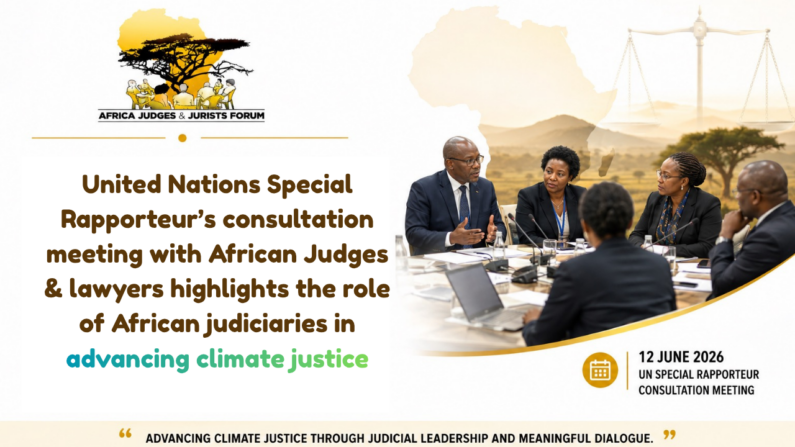
12 June 2026
The African Judges and Jurists Forum (AJJF) convened a virtual consultation on 12 June 2026 with the United Nations Special Rapporteur on the Independence of Judges and Lawyers, Professor Margaret Satterthwaite. The purpose of the meeting was for African judges and jurists to provide input into the UN Special Rapporteur’s upcoming thematic report to the United Nations General Assembly on judicial independence in the context of the climate crisis.
The consultation brought together judges, legal scholars and jurists from multiple African jurisdictions to share their experiences and insights on the role of courts in promoting climate justice. Discussions focused on three key themes: access to justice and public participation in climate-related litigation, effective judicial remedies for environmental harm, and strengthening climate competence within judiciaries.
Participants observed the increasingly complex intersection of climate change, human rights, and the rule of law. Amid growing environmental challenges and resource constraints, speakers highlighted the critical importance of safeguarding judicial independence and ensuring that courts remain capable of delivering timely and effective justice.
Participants also stressed the need for structured and continuous judicial education on climate justice, environmental law, and climate litigation. Judges highlighted that many judicial officers are increasingly required to assess complex scientific evidence related to climate change and yet they have limited knowledge and skills to do so. They emphasised the importance of multidisciplinary learning, collaboration with scientific experts, and the development of practical tools such as climate litigation bench books, scientific evidence guidelines, and judicial reference materials. Several speakers called for the integration of climate change and environmental justice into judicial training curricula and continuing professional development programmes.
The discussion also examined barriers to access to justice in environmental and climate-related cases. Participants identified restrictive rules regulating legal standing, procedural hurdles, evidentiary challenges, and limited legal aid as obstacles that prevent affected communities from seeking judicial remedies. There were calls for reform of rules regulating legal standing in litigation, strengthened legal aid mechanisms, and the establishment of specialised environmental courts or tribunals to enhance judicial efficiency and expertise.
Country experiences highlighted both progress and ongoing challenges. Botswana’s strong environmental governance framework was recognised as a foundation for future climate litigation, while Malawi outlined difficulties in operationalising an environmental tribunal due to resource constraints. Somaliland underscored the need for institutional support and long-term judicial capacity-building, while Kenya emphasised gaps in climate-specific judicial resources and interdisciplinary engagement.
On the issue of effective relief and remedies, participants explored judicial approaches that can deliver meaningful outcomes for communities affected by environmental harm. Declaratory and structural remedies, including court orders requiring governments to develop and implement climate action plans, were identified as particularly impactful. Participants also discussed the importance of compliance monitoring mechanisms, realistic implementation timelines, and mandatory disclosure orders that improve public access to environmental information.
The consultation further highlighted the value of African indigenous knowledge systems and customary law in addressing environmental and climate justice challenges. Speakers noted that customary legal systems often provide important mechanisms for community participation and environmental stewardship, yet remain underutilised in formal judicial processes. Participants called for additional research, training, and policy development to strengthen the integration of indigenous knowledge into environmental adjudication.
Throughout the discussions, judges emphasised that climate justice requires not only strong legal frameworks but also independent, informed, and adequately resourced judiciaries capable of addressing increasingly complex environmental disputes.
Concluding the meeting, participants reaffirmed the importance of regional cooperation, peer learning, and international collaboration in strengthening judicial responses to climate change.
For more information contact: Martin Masiga, Africa Judges and Jurists Secretary General
Tel: +256 753 954 308 | Email: okumu-masiga@africajurists.org