
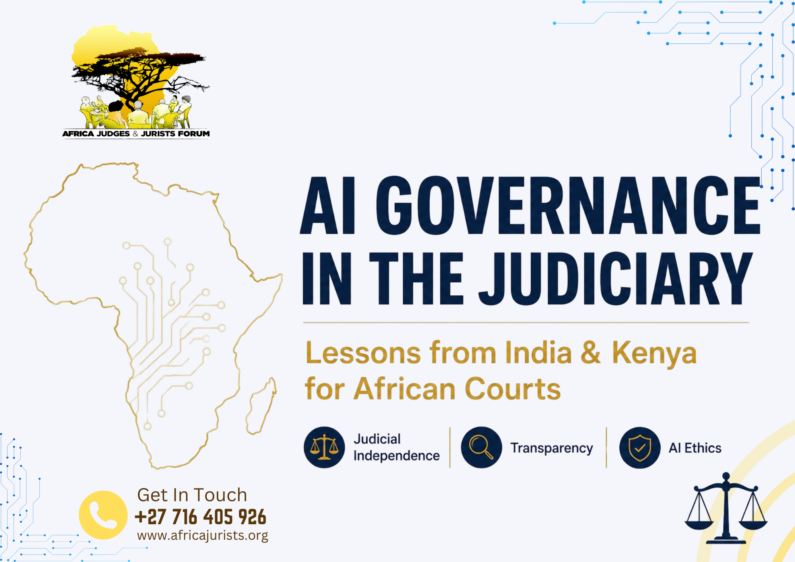
Artificial Intelligence (AI) is rapidly transforming justice systems around the world. From legal research and case management to transcription and translation services, courts are increasingly exploring how AI can improve efficiency, accessibility, and service delivery. However, the adoption of AI within judicial systems raises important questions about judicial independence, transparency, accountability, fairness, and the protection of fundamental rights.
Recent developments in India and Kenya demonstrate how judiciaries are beginning to address these challenges through dedicated governance frameworks.
India’s Draft Regulations on AI in Courts
In June 2026, the Supreme Court of India published draft Regulations for Use of Artificial Intelligence in Courts, 2026, establishing one of the most comprehensive judicial AI governance frameworks currently under consideration globally. The regulations are grounded in the principles of human primacy, transparency, accountability, data protection, and judicial independence. They permit the use of AI for functions such as legal research, translation, transcription, drafting assistance, and case management, while expressly prohibiting AI from determining judicial outcomes or replacing judicial reasoning.
SUPREME COURT OF INDIA
View a full pdf: Seeking views/suggestions of all stakeholders and the general public on draft : Regulations for Use of Artificial Intelligence (AI) in Courts, 2026
Kenya’s Emerging Judiciary AI Framework
The Judiciary of Kenya is also developing an Artificial Intelligence Adoption Policy Framework to guide the ethical and responsible integration of AI into judicial operations. The framework seeks to enhance judicial efficiency while safeguarding judicial independence, data privacy, due process, and constitutional values. The initiative forms part of the Judiciary’s broader digital transformation agenda.
View a full pdf:Judiciary AI Policy 2.0 – V3
Key Lessons for African Judiciaries
The approaches emerging from India and Kenya offer valuable lessons for courts across Africa.
Human Oversight Must Remain Central
Both frameworks recognize that AI should serve as an assistive tool rather than a substitute for judicial decision-making. Responsibility for judicial decisions must remain exclusively with judges and judicial officers.
Judicial Independence Requires Protection
AI systems should never influence judicial reasoning, interpretation of facts, or determination of legal rights. Safeguards are necessary to ensure that technology supports rather than undermines judicial independence.
Transparency and Accountability Are Essential
Judiciaries must establish clear rules governing the use of AI, including disclosure requirements, audit mechanisms, and accountability structures for AI-assisted processes.
Data Protection Must Be Prioritized
Court records often contain highly sensitive personal information. Robust safeguards are therefore required to protect privacy, confidentiality, and data security when AI systems are deployed within judicial environments.
Risk-Based Regulation Is Necessary
As courts increasingly experiment with AI, governance frameworks must identify and mitigate risks relating to bias, hallucinations, inaccurate outputs, and overreliance on automated systems. Recent judicial experiences in both India and Kenya illustrate the importance of maintaining strong human verification processes.
Looking Ahead
The question facing African judiciaries is no longer whether AI will be used in the administration of justice, but how to use it responsibly. As courts across the continent pursue digital transformation, the experiences of India and Kenya provide valuable guidance for developing AI governance frameworks that enhance efficiency while preserving judicial independence, fairness, accountability, and public trust.
For Africa’s justice sector, the challenge will be to harness the opportunities presented by AI while ensuring that technology remains firmly anchored in constitutional values, human rights, and the rule of law.