
8 JUNE 2026
The Africa Judges and Jurists Forum (AJJF) notes the address by President Cyril Ramaphosa on migration, delivered on 7 June 2026, against the background of heightened public concern over migration governance and reported attacks on foreign nationals in South Africa.
AJJF welcomes the President’s clear affirmation that the responsibility for enforcing immigration laws rests with the State, and the State alone. This is an important restatement of constitutional governance and the rule of law. No private group or individual may assume powers to demand proof of nationality, intimidate foreign nationals, deny access to services, or enforce immigration law outside lawful authority.
The address appropriately recognises that public concerns about unemployment, service delivery, public safety and pressure on essential services are real and deserve serious governmental attention. At the same time, it correctly cautions that migration is not the cause of all South Africa’s economic challenges. This distinction is essential to prevent vulnerable communities from becoming scapegoats for deeper structural governance and socio-economic failures.
AJJF further welcomes the President’s rejection of xenophobia, Afrophobia, racism and all forms of intolerance. The commitment to uphold the human rights of all persons within South Africa, whether citizens or foreign nationals, is consistent with South Africa’s Constitution, its international obligations, and the values of human dignity and Ubuntu.
The proposed measures on border management, labour inspections, anti-corruption action within immigration systems, employer accountability, and engagement with sister African countries are important. However, their adequacy will depend on implementation that is lawful, proportionate, non-discriminatory and subject to appropriate oversight. Particular attention must be given to the immediate protection of vulnerable migrant communities, access to remedies for victims of violence, and accountability for any acts of vigilantism or official neglect.
AJJF also notes the broader regional implications of the migration question. South Africa’s future is inseparable from that of the African continent. Migration governance must therefore be approached not only as a domestic law enforcement issue, but also as a matter of regional cooperation, African solidarity and responsible continental leadership. This is especially important at a time when Africa requires greater unity in the face of weakening multilateralism, rising geopolitical competition, and renewed extractive interest in the continent’s critical minerals.
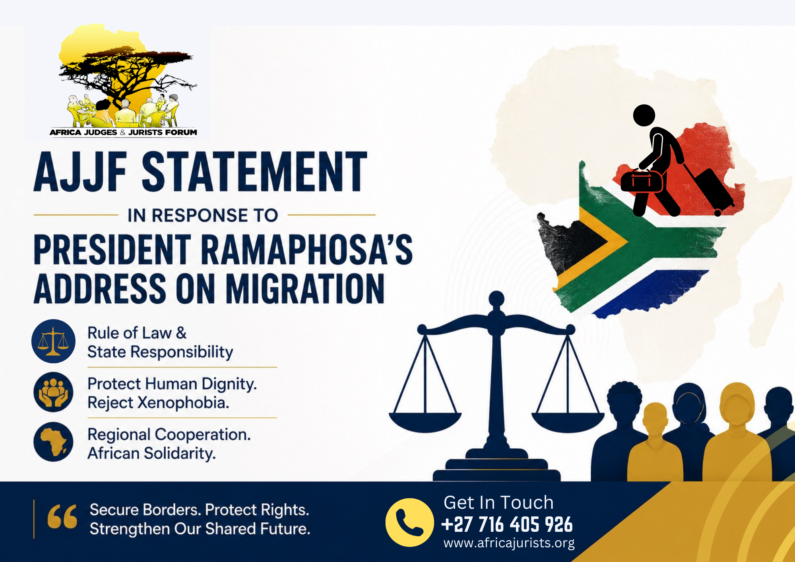
A principled response must therefore hold together three imperatives: the legitimate authority of the State to regulate migration; the duty to protect all persons from violence and discrimination; and the broader African integration agenda that recognises the interconnected histories, economies and communities of the region.
AJJF calls for migration governance rooted in legality, constitutionalism, human dignity, regional cooperation and accountable state action. South Africa can and must secure its borders while protecting vulnerable communities, enforcing its laws while upholding constitutional rights, and addressing legitimate public grievances without permitting violence, scapegoating or Afrophobic mobilisation.