
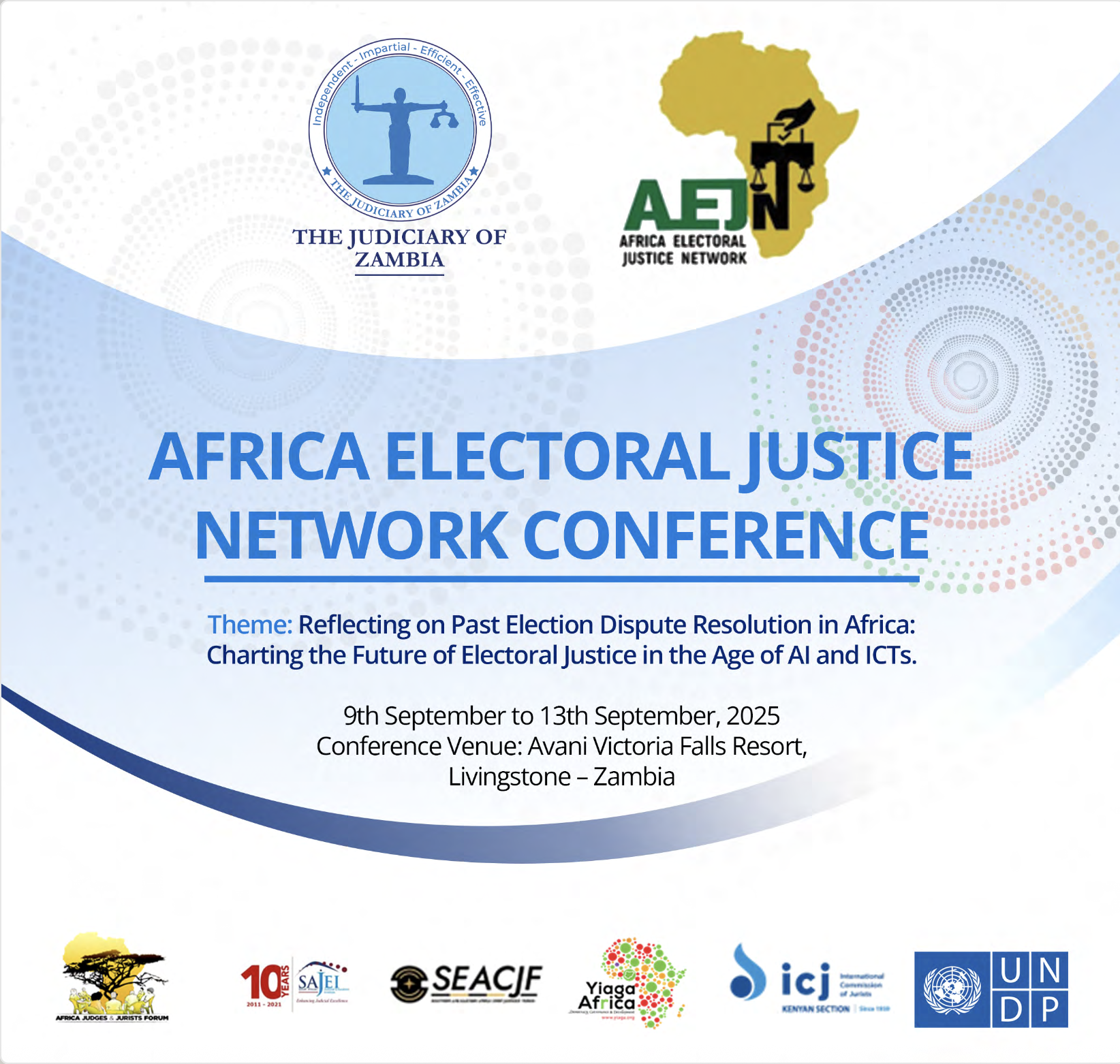
Livingstone, Zambia | 9–13 September 2025
The Africa Judges and Jurists Forum (AJJF) proudly participated as a strategic partner in the 4th Annual Conference of the Africa Electoral Justice Network (AEJN), held in Livingstone, Zambia from 9–13 September 2025. This landmark gathering brought together judges, electoral justice practitioners, civil society leaders, and legal experts from across the continent to reflect on the evolving landscape of electoral dispute resolution in the age of Artificial Intelligence (AI) and Information and Communication Technologies (ICTs).
A Pan-African Platform for Electoral Justice
The AEJN is a regional forum that convenes judicial officers, electoral management bodies (EMBs), civil society organisations, and legal experts to share knowledge and strengthen electoral jurisprudence. This year’s conference, themed “Reflecting on Past Electoral Dispute Resolution in Africa: Charting the Future of Electoral Justice in the Age of AI and ICTs,” examined both the opportunities and risks that emerging technologies present for elections across Africa
The conference culminated in the validation and adoption of a Toolkit on Judicial Oversight of Artificial Intelligence in African Elections, a milestone in promoting ethical and transparent use of AI to protect electoral integrity.
Keynote Remarks by AJJF
Representing AJJF, Justice Charles Mkandawire of the Supreme Court of Malawi delivered powerful remarks on the critical role of the judiciary in safeguarding electoral justice
He underscored:
- The centrality of the vote in any democracy and the imperative that electoral dispute resolution upholds the will of the people.
- The growing challenge of the judicialisation of politics, warning that politicisation of courts threatens public confidence in judicial independence.
- The AEJN’s value as a safe space for judges to share experiences and strengthen best practices across jurisdictions without external pressure.
Justice Mkandawire reaffirmed AJJF’s commitment to supporting the AEJN with resources and technical expertise to ensure that African judiciaries are empowered to meet these challenges.
Strategic Outcomes and Resolutions
The conference adopted far-reaching resolutions to guide the future of electoral justice in Africa, including:
- Specialised training for judges and election practitioners in digital forensics and AI-related electoral law.
- Development of model policy frameworks for the responsible use of AI and ICTs in electoral processes.
- Public education campaigns to build citizen trust in electoral technology.
- The creation of an expert panel to draft model AI and ICT policy frameworks for African elections
These commitments reflect a collective determination to ensure that every vote counts and that electoral dispute resolution remains independent, credible, and technologically informed.
AJJF’s Continued Role
As a co-organiser and long-standing supporter of the AEJN, AJJF remains dedicated to promoting judicial independence, electoral integrity, and the rule of law across Africa. Through initiatives like the AEJN and its growing network of jurists, AJJF continues to strengthen the capacity of African courts to address the complex challenges posed by technology in electoral processes.
📄 Read the Official Documents
- AEJN Conference – Programme + Information Note
- AEJN 2025 Conference Final Communique
- Remarks by Justice Charles Mkandawire
For more information on the elections and rule of law programme in Africa, please contact the Secretary General Martin Masiga at okumu-masiga@africajurists.org or the Elections and Rule of Law Expert Arnold Tsunga at tsunga@africajurists.org